
The short answer
Overthinking is getting stuck going over the same thoughts without reaching a decision or a solution. It usually takes two forms: rumination about the past and worry about the future. To stop, first notice that you are in the loop, then ask whether there is a concrete step you can take. If there is, take it. If not, shift your attention to something absorbing, set aside a fixed worry time, write the thoughts down, talk to yourself as you would to a friend and accept a good enough decision instead of a perfect one.
You sent a message to a friend three hours ago and she hasn’t replied. Since then you have reread it six times. Was it too much? Did it sound cold? Is she annoyed about last weekend? You’ve drafted two follow-up messages and deleted both. Then she replies: “Sorry, was at the dentist! Yes, Saturday’s great.”
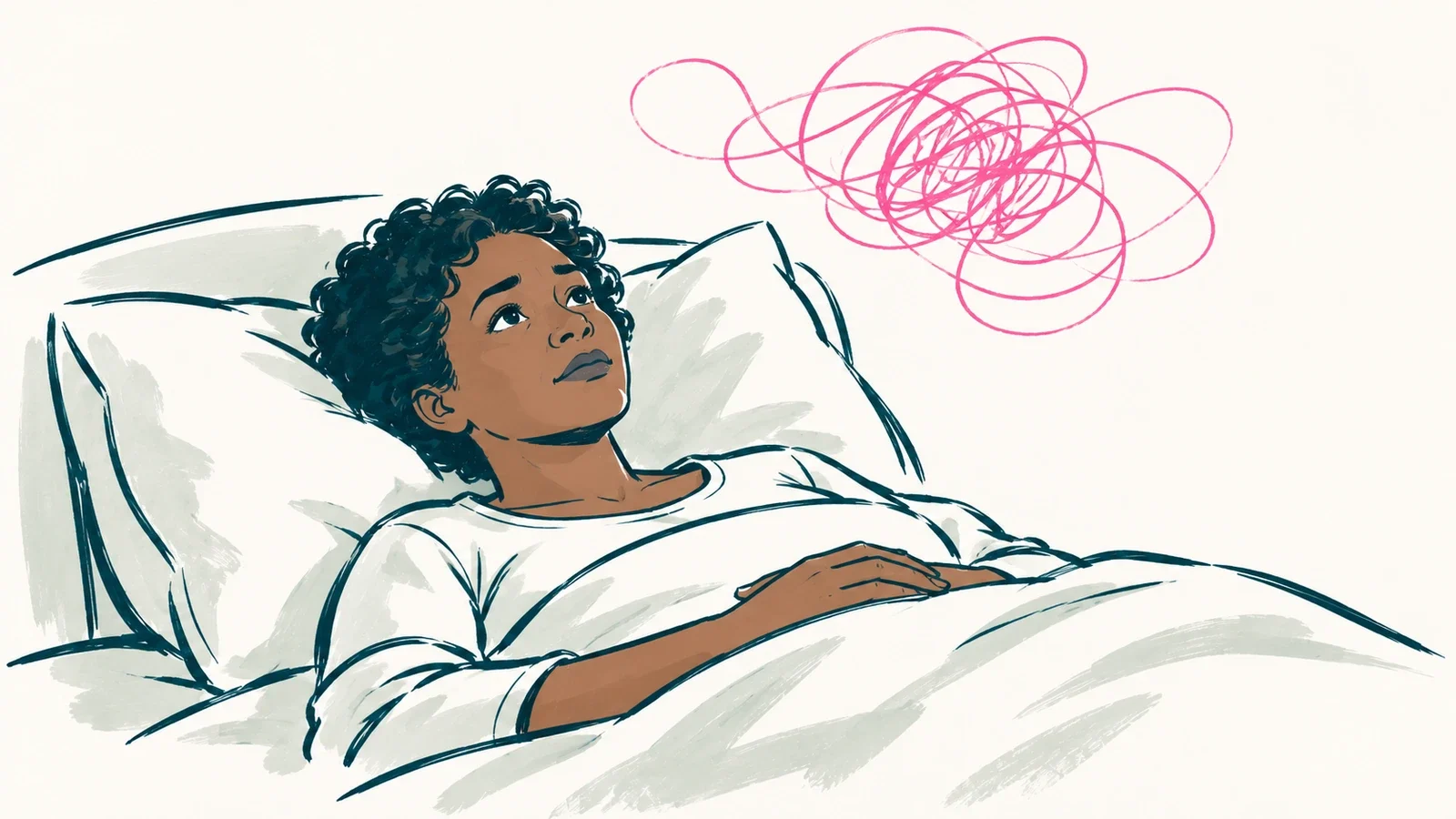
If that sounds familiar, you’re far from alone. Overthinking is one of the most common complaints people bring to therapists, and one of the most exhausting habits a mind can have. It feels like thinking hard about something important. In practice, it’s usually thinking in circles.
What overthinking is
Overthinking means going over the same thoughts again and again without getting anywhere. It tends to come in two forms:
- Rumination looks backward: replaying a conversation, a mistake, a decision. Why did I say that? What did they mean? What if I’d done it differently?
- Worry looks forward: rehearsing everything that might go wrong. What if I lose my job? What if the test result is bad? What if they say no?
Both feel useful. Both promise that if you just think about it a bit more, you’ll find the answer or be ready for the worst. But they rarely deliver.
The psychologist Susan Nolen-Hoeksema spent decades studying rumination. Her research showed that people who tend to brood on their problems are more likely to become depressed, stay depressed longer and solve problems less well than people who don’t. Overthinking doesn’t just fail to help. It often makes things worse.
Why you overthink everything
It feels like problem-solving
The mind is built to solve problems, and overthinking looks like problem-solving from the inside. The difference is that real problem-solving moves toward a decision or an action. Overthinking moves in circles.
Uncertainty is uncomfortable
Many overthinkers find it very hard to live with not knowing. Going over things again and again is an attempt to reach certainty: to be sure the friend isn’t upset, sure the plan will work. Since certainty usually isn’t available, the thinking never ends.
You’re anxious or low
Overthinking is both a symptom and a cause of anxiety and low mood. When you feel anxious, your mind scans for threats. When you feel low, it pulls up memories of failures. Both give overthinking plenty to work with. We look at the bigger picture in How to Manage Anxiety.
You’re a perfectionist
If you believe there is one right answer to every decision, and that getting it wrong would be a disaster, every choice turns into a long deliberation.
You have time and nothing to fill it
Overthinking flourishes in empty moments: lying in bed, sitting in traffic, standing in the shower. When the mind isn’t occupied, it goes looking for problems. It’s often worst at night, as we explain in Why Is Anxiety Worse at Night?
How to tell useful thinking from overthinking
Ask yourself two questions:
- Am I getting closer to a decision or an action? If the last twenty minutes produced a plan, a choice or a next step, that’s thinking. If you’re in the same place you started, it’s overthinking.
- Is this something I can do anything about right now? If the answer is no, more thinking won’t change that.
The psychologist Edward Watkins has found that the style of thinking matters too. Concrete thinking, about how something happened and what to do next, tends to help. Abstract thinking, about why things always go wrong or what it says about you, tends to keep people stuck.
How to stop overthinking
1. Notice the loop
The first step is simply catching yourself. Overthinking is often automatic, and many people only realize they’ve been doing it after an hour has gone by. A simple label helps: “I’m overthinking again.” It creates a small gap between you and the thoughts.
2. Turn it into one concrete step
If there is something you can do, find the smallest step and take it. Send the message. Book the appointment. Write down the three options and choose one. Action is the natural exit from a loop of thought.
3. If there’s nothing to do, shift your attention
Telling yourself to stop thinking about something rarely works. Research by Daniel Wegner on thought suppression famously found that people told not to think about a white bear thought about it more. What works better is giving your mind something else to hold: a conversation, a puzzle, a walk, cooking, music, something with your hands. The aim isn’t to run away from the problem, only to stop circling it.
4. Give worries a time slot
Choose a fixed fifteen to thirty minutes in the day, not too close to bedtime, as your worry time. When a worry pops up at another moment, jot it down and tell yourself you’ll deal with it then. When the time comes, go through the list. Many people find half the worries no longer seem important.
5. Write it down
Thoughts going round in your head seem bigger and more tangled than they are. Writing them on paper slows them down and lets you see them clearly. You can also split the page into two columns: things I can do something about, and things I can’t.
6. Talk to yourself like a friend
Overthinking often uses a harsh inner voice. The psychologist Ethan Kross has studied what he calls distanced self-talk: thinking about your situation using your own name or “you” instead of “I”. In his experiments, people who did this felt less anxious and handled stressful tasks better. “Anna, you sent a friendly message. She’s probably just busy” lands differently from “Why did I send that?”
7. Accept good enough
For many decisions, there’s no perfect answer. The psychologist Barry Schwartz has shown that people who always look for the best option, whom he calls maximizers, often end up less satisfied than people who choose the first option that meets their standards. Most decisions can be undone or adjusted. Making one and moving on is often better than waiting for certainty.
8. Look after the basics
Tiredness, hunger and stress all make overthinking worse. So does a constant stream of information from your phone. Some quiet time without input, and a reasonable bedtime, can do more than any technique.
When overthinking is something more
Sometimes constant overthinking is a sign of an anxiety disorder, depression or obsessive-compulsive disorder. If your thoughts are taking up hours of your day, keeping you awake most nights or stopping you from doing things, talk to a doctor or a therapist. Cognitive behavioral therapy and related approaches, including rumination-focused CBT, are designed specifically to help.
A small practice
The next time you catch yourself overthinking, set a timer for two minutes and write down everything going through your head, without editing. When the timer goes, read it back once and circle anything you can actually act on. Do the first circled thing, or schedule it. Then put the paper away and do something with your hands for ten minutes.
For more on calming the anxious mind, see How to Manage Anxiety.
Frequently asked questions
Why do I overthink everything?
Usually because overthinking feels like problem-solving, because uncertainty is uncomfortable, and because anxiety, low mood, perfectionism and tiredness all give the mind more to chew on.
Is overthinking a mental illness?
No. It’s a habit almost everyone has to some degree. But constant overthinking can be part of anxiety, depression or OCD, so if it’s taking over your days, it’s worth getting help.
How do I stop overthinking at night?
Write your worries down before bed, keep a notepad by the bed for new ones, and if you can’t sleep after about twenty minutes, get up and do something calm until you feel sleepy.
How do I stop overthinking in a relationship?
Notice when you’re reading meaning into small things, check the facts instead of guessing, and ask directly when something matters. A short, honest question usually settles more than an evening of thinking.