
The short answer
Awe is the feeling of encountering something vast that you can’t easily take in, whether a mountain, the night sky, great music or an act of extraordinary kindness. Psychologists Dacher Keltner and Jonathan Haidt describe it as a mix of vastness and the need to make sense of something new. Research links awe with a smaller, quieter sense of self, more generosity, more connection to others and better mood, and some studies link it to lower inflammation. You can feel awe more often by spending time in nature, noticing everyday wonders and slowing down to look.
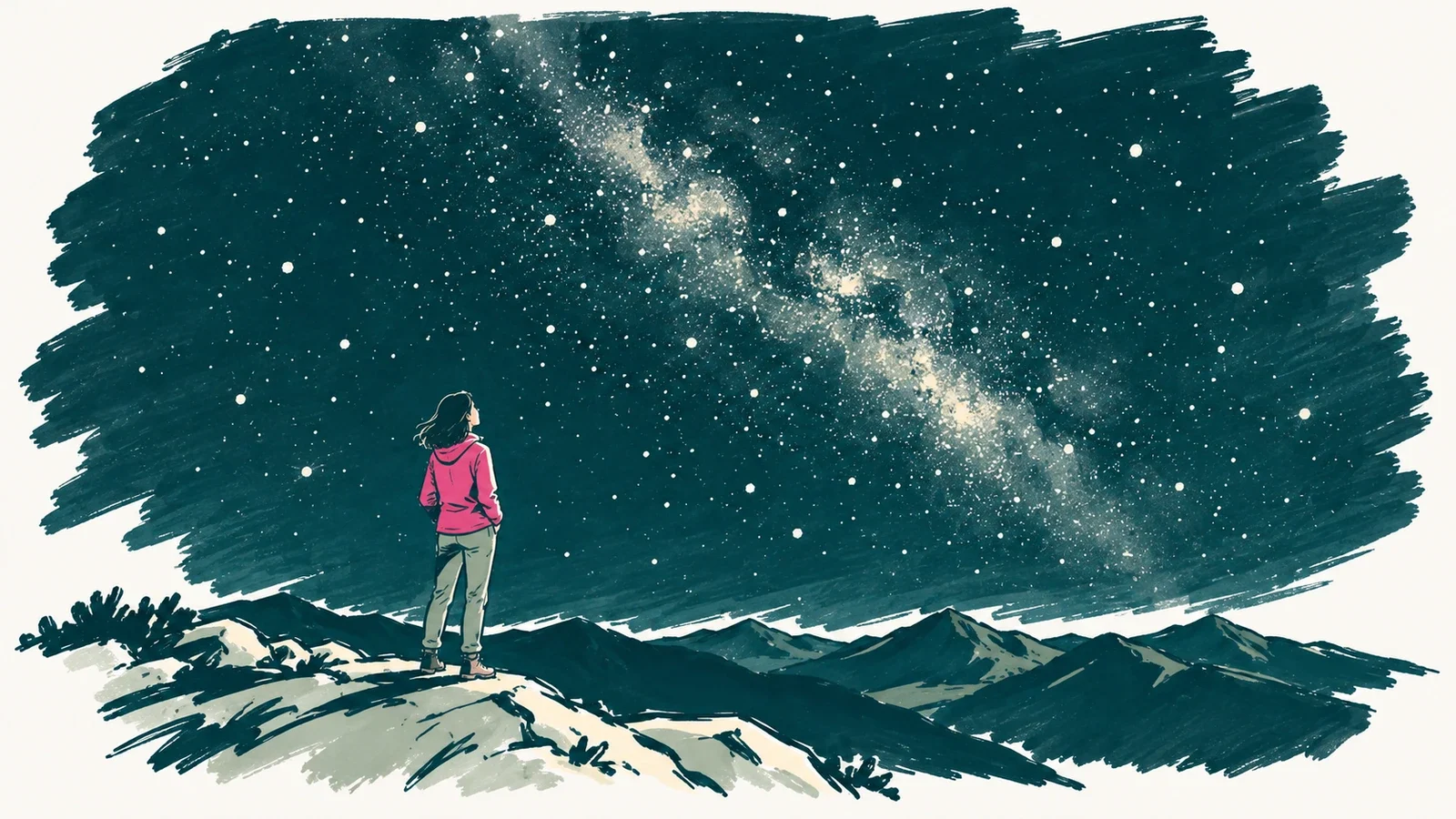
You stand at the edge of the ocean and watch the waves roll in. Or you look up at a sky so full of stars that you can’t make out the constellations. Or you hear a piece of music that makes the hair on your arms stand up. For a moment, your everyday worries fall away. You feel small, but not in a bad way. You feel part of something much bigger.
That feeling is awe. It’s one of the least talked-about emotions, and one of the most powerful. In recent years, researchers have started to study it closely, and what they’ve found suggests that awe is not just pleasant but genuinely good for us.
What awe is
In a 2003 paper, the psychologists Dacher Keltner and Jonathan Haidt described awe as having two key ingredients:
- Vastness: encountering something much larger than yourself, in size, power, beauty, skill or meaning.
- Accommodation: a need to adjust your understanding, because what you’re experiencing doesn’t fit easily into what you already know.
Awe can be triggered by many things:
- Nature: mountains, oceans, storms, forests, the night sky.
- Art and music: a great painting, a symphony, a moving performance.
- Other people: acts of courage, kindness or extraordinary skill.
- Ideas: a scientific discovery, a profound insight, the scale of the universe.
- Life events: the birth of a child, the death of someone close.
- Spiritual or religious experiences.
In his later research, Keltner asked thousands of people from around the world about experiences of awe. The most common sources weren’t mountains or cathedrals but other people: acts of kindness, courage and strength.
Awe can also have a darker side. Storms, disasters and overwhelming power can bring awe mixed with fear. But most of the time, awe is a positive emotion.
Why awe is good for you
It quiets the self
One of the most consistent findings in awe research is something called the small self. In awe, people tend to feel that their own concerns and worries matter less. In a 2022 study, Virginia Sturm and colleagues asked older adults to take a weekly fifteen-minute awe walk, paying attention to the vastness and detail of the world around them. Compared with people taking ordinary walks, the awe walkers reported more joy and prosocial positive emotions. In the photos they took of themselves during their walks, they increasingly made themselves smaller in the frame and included more of the scene around them.
For people who tend to overthink or worry, this shift can be a relief.
It makes people kinder
In a 2015 study, Paul Piff and colleagues had some participants spend a minute looking up at a grove of very tall eucalyptus trees, while others looked at a tall building. When a researcher then “accidentally” dropped a handful of pens, the people who had looked at the trees picked up more of them. Across several studies, awe was linked with more generous and ethical behavior.
It connects us to others
Because awe makes the self feel smaller, it can also make people feel more connected to others and to the world. Many people describe awe experiences as moments of feeling part of something larger.
It may be good for the body
In a 2015 study, Jennifer Stellar and colleagues found that people who reported feeling awe more often had lower levels of interleukin-6, a marker of inflammation linked to several health problems. Among the positive emotions they measured, awe was the strongest predictor of lower inflammation. This research is still developing, but it suggests awe may matter for physical health as well as mood.
It changes how time feels
Research by Melanie Rudd and colleagues found that people feeling awe perceived themselves as having more time available, and were more patient and less inclined toward material things. In a busy life, that can feel like a gift.
It sparks curiosity
Because awe confronts us with something we don’t fully understand, it often leads to wonder and a desire to learn more. It’s closely linked to curiosity, which we look at in Why Is Curiosity Important?
How to feel awe more often
You don’t need to travel to the Grand Canyon to feel awe. It’s available in ordinary life if you know where to look.
Spend time in nature
Even local nature can bring awe: a big tree, a sunset, a storm rolling in, the patterns of frost on a window. Try going for an awe walk like the participants in Sturm’s study: walk somewhere with a bit of nature and pay deliberate attention to things that are vast or intricate.
Look up
Many people spend most of their day looking down at screens. Looking up, at clouds, trees, the sky at night, is one of the simplest ways to invite awe.
Notice everyday wonders
A child learning to walk, the complexity of a flower, the fact that you can talk to someone on the other side of the world. Awe often lives in things we’ve stopped noticing.
Be moved by people
Notice acts of kindness, courage and skill around you. Read or watch stories of people doing remarkable things. Keltner’s research suggests these are among the most common triggers of awe.
Seek out art and music
Go to a concert, visit a museum, listen to music that moves you with your full attention. Let yourself be absorbed.
Learn about the world
Science, history and nature documentaries can bring awe at the scale of the universe, the age of the Earth or the complexity of life.
Slow down
Awe needs attention. It’s hard to feel it while rushing. Give yourself time to stop and take things in.
A small practice
This week, take one twenty-minute awe walk. Go somewhere with a bit of nature, a park, a river, a quiet street with old trees. Leave your phone in your pocket. Walk slowly, and look for anything that surprises you with its size, beauty or detail. When you find it, stop for a moment and take it in. At the end, take a photo of the view, not of yourself.
For more on positive emotions, see Positive Emotions.
Frequently asked questions
What is awe?
Awe is the feeling of encountering something vast that you can’t easily take in, such as a mountain, the night sky, great music or an act of extraordinary kindness.
Why is awe good for you?
Research links awe with a quieter sense of self, more generosity, greater connection to others, better mood, more patience and, in some studies, lower inflammation.
How can I feel more awe?
Spend time in nature, look up, notice everyday wonders, be moved by other people’s kindness and courage, seek out art and music and slow down to take things in.
Is awe a positive or negative emotion?
Usually positive. But awe can be mixed with fear when it’s triggered by something threatening, like a storm or a natural disaster.